




This therapist directory is offered in partnership with BetterHelp. If you sign up for therapy after clicking through from this site, HelpGuide will earn a commission. This helps us continue our nonprofit mission and continue to be there as a free mental health resource for everyone.
Need to talk to someone now? Find a crisis helpline
If you're a BetterHelp therapist with questions about your directory listing, please contact therapists@betterhelp.com
Can’t sleep? If you struggle to fall asleep or stay asleep at night, it can take a huge toll on your health. Here’s how to beat insomnia and end the sleepless nights.

Insomnia is the inability to fall asleep or stay asleep at night, resulting in unrefreshing or non-restorative sleep. It’s a common problem. One 2025 analysis published in the Journal of Sleep Research estimates that chronic insomnia affects about 12.4 percent of the population. However, at least an additional 20 percent of people experience it on an occasional basis. Insomnia takes a toll on your energy, mood, and ability to function during the day. And when it’s chronic, it can even contribute to serious health problems.
Some people struggle to get to sleep no matter how tired they are. Others wake up in the middle of the night and lie awake for hours, anxiously watching the clock. But, because different people need different amounts of sleep, insomnia is defined by the quality of your sleep and how you feel after sleeping—not the number of hours you sleep or how quickly you doze off. Even if you’re spending eight hours a night in bed, if you feel drowsy and fatigued during the day, you may be experiencing insomnia.
Although insomnia is the most common sleep complaint, it is not a single sleep disorder. It’s more accurate to think of it as a symptom of another problem, whether it’s something as simple as drinking too much caffeine during the day or something more complex like feeling overloaded with stress.
The good news is that most cases of insomnia can be cured with changes you can make on your own—without relying on sleep specialists or turning to prescription or over-the-counter sleeping pills. By addressing the underlying causes and making simple changes to your daily habits and sleep environment, you can put a stop to the frustration of insomnia and finally get a good night’s sleep.
Try listening to HelpGuide’s Sleep Meditation Using Guided Imagery or Deep Breathing Meditation.
These include:
Rather than struggle with these issues night after night, it’s important to take proactive steps to address the root causes of your insomnia. Know that you don’t have to do it all alone. A mental health professional can guide you toward helpful strategies and tools.
BetterHelp is an online therapy service that matches you to licensed, accredited therapists who can help with depression, anxiety, relationships, and more. Take the assessment and get matched with a therapist in as little as 48 hours.
Take Assessment HelpGuide is user supported. We earn a commission if you sign up for BetterHelp’s services after clicking through from this site. Learn moreIn order to properly treat and cure your insomnia, you need to become a sleep detective. Emotional issues such as stress, anxiety, and depression cause half of all insomnia cases. But your daytime habits, sleep routine, and physical health may also play a role. Try to identify all possible causes of your insomnia. Once you figure out the root cause, you can tailor treatment accordingly.
Sometimes, insomnia only lasts a few days and goes away on its own, especially when it is tied to an obviously temporary cause, such as stress over an upcoming presentation, a painful breakup, or jet lag. Other times, insomnia is stubbornly persistent. Chronic insomnia is usually tied to an underlying mental or physical issue.
Anxiety, stress, and depression are some of the most common causes of chronic insomnia. Having difficulty sleeping can also make anxiety, stress, and depression symptoms worse. Other common emotional and psychological causes include anger, worry, grief, bipolar disorder, and trauma. Treating these underlying problems is essential to resolving your insomnia.
Medical problems or illness. Many medical conditions and diseases can contribute to insomnia, including asthma, allergies, Parkinson’s disease, hyperthyroidism, acid reflux, kidney disease, and cancer. Chronic pain is also a common cause of insomnia.
Medications. Many prescription drugs can interfere with sleep, including antidepressants, stimulants for ADHD, corticosteroids, thyroid hormone, high blood pressure medications, and some contraceptives. Common over-the-counter culprits include cold and flu medications that contain alcohol, pain relievers that contain caffeine (Midol, Excedrin), diuretics, and slimming pills.
Sleep disorders. Insomnia is itself a sleep disorder, but it can also be a symptom of other sleep disorders, including sleep apnea, restless legs syndrome, and circadian rhythm disturbances tied to jet lag or late-night shift work.
While treating underlying physical and mental issues is a good first step, it may not be enough to cure your insomnia. You also need to look at your daily habits. Some of the things you’re doing to cope with insomnia may actually be making the problem worse.
For example, maybe you’re using sleeping pills or alcohol to fall asleep, which disrupts sleep even more over the long-term. Or maybe you drink excessive amounts of coffee during the day, making it harder to fall asleep later. Other daytime habits that can negatively impact your ability to sleep at night include having an irregular sleep schedule, napping, eating sugary foods or heavy meals too close to bedtime, and not getting enough exercise or exercising too late in the day.
Not only can poor daytime habits contribute to insomnia, but a poor night’s sleep can make these habits harder to correct, creating a vicious cycle of unrefreshing sleep:
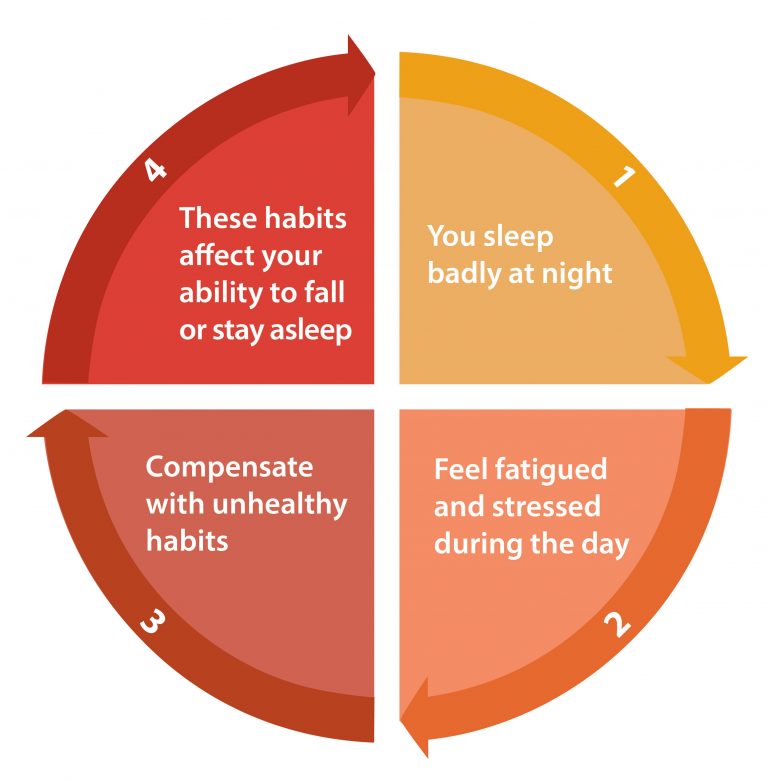
Oftentimes, changing the habits that are reinforcing sleeplessness is enough to overcome the insomnia altogether. It may take a few days for your body to get used to the change, but once you do, you’ll sleep better.
Some habits are so ingrained that you may overlook them as a possible contributor to your insomnia. Maybe your Starbucks habit affects your sleep more than you realize. Or maybe you’ve never made the connection between that late-night glass of wine and your sleep difficulties.
Keeping a sleep diary (or using a sleep tracking app) is a helpful way to pinpoint habits and behaviors contributing to your insomnia.
Two powerful weapons in the fight against insomnia are a quiet, comfortable bedroom and a relaxing bedtime routine. Both can make a big difference in improving the quality of your sleep.
Make sure your bedroom is quiet, dark, and cool. Noise, light, a bedroom that’s too hot or cold, or an uncomfortable mattress or pillow can all interfere with sleep. Try using a sound machine or earplugs to mask outside noise. An open window or fan can keep the room cool. Blackout curtains or an eye mask are often effective in blocking out light. Experiment with different levels of mattress firmness, foam toppers, and pillows that provide the support you need to sleep comfortably.
Stick to a regular sleep schedule. Support your biological clock by going to bed and getting up at the same time every day, including weekends. Get up at your usual time in the morning even if you’re tired. This will help you get back in a regular sleep rhythm.
Turn off all screens at least an hour before bed. Electronic screens emit a blue light that disrupts your body’s production of melatonin and combats sleepiness. So instead of watching TV or spending time on your phone, tablet, or computer, choose another relaxing activity, such as reading a book or listening to soft music.
Avoid stimulating activity and stressful situations before bedtime. This includes checking messages on social media, big discussions or arguments with your spouse or family, or catching up on work. Postpone these things until the morning.
Avoid naps. Napping during the day can make it more difficult to sleep at night. If you feel like you have to take a nap, limit it to 30 minutes before 3 p.m.
Drinking too many liquids. Waking up at night to go to the bathroom becomes a bigger problem as we age. By not drinking anything an hour before sleep and going to the bathroom several times as you get ready for bed, you can reduce the frequency you’ll wake up to go during the night.
Alcohol. While a nightcap may help you to relax and fall asleep, it interferes with your sleep cycle once you’re out, causing you to wake up during the night.
Big evening meals. Try to eat dinner earlier in the evening, and avoid heavy, rich foods within two hours of going to bed. Spicy or acidic foods can cause stomach trouble and heartburn, which can wake you during the night.
Caffeine. The American Academy of Sleep Medicine recommends that you stop drinking caffeinated beverages at least six hours before bedtime. People who are sensitive to caffeine may need to stop even earlier.
The more trouble you have with sleep, the more it starts to invade your thoughts. You may dread going to sleep because you just know that you’re going to toss and turn for hours or wake up at 2 a.m. again. Or maybe you’re worried because you have a big day tomorrow, and if you don’t get a solid 8 hours, you’re sure you’ll blow it?
Agonizing and expecting sleep difficulties only makes insomnia worse. Worrying about getting to sleep or how tired you’re going to be floods your body with adrenaline. Then, before you know it, you’re wide-awake.
If sleep worries are getting in the way of your ability to unwind at night, the following strategies may help. The goal is to train your body to associate the bed with sleep and nothing else—especially not frustration and anxiety.
Use the bedroom only for sleeping and sex. With many of us working from home, it can be difficult to avoid, but if possible don’t work, use your computer, or watch TV in your bedroom. The goal is to associate the bedroom with sleep alone, so that your brain and body get a strong signal that it’s time to nod off when you get into bed.
Move bedroom clocks out of view. Anxiously watching the minutes tick by when you can’t sleep—knowing that you’re going to be exhausted when the alarm goes off—is a surefire recipe for insomnia. You can use an alarm, but make sure you can’t see the time when you’re in bed.
Get out of bed when you can’t sleep. Don’t try to force yourself to sleep. Tossing and turning only amps up your anxiety. Get up, leave the bedroom, and do something relaxing, such as reading, meditating, or taking a bath. When you’re sleepy, go back to bed.
It’s also helpful to challenge the negative attitudes about sleep and your insomnia problem that you’ve developed over time. The key is to recognize self-defeating thoughts and replace them with more realistic ones.
| Self-defeating thought: | Sleep-promoting comeback: |
|---|---|
| Unrealistic expectations: I should be able to sleep well every night like a normal person. I shouldn’t have a problem! | Lots of people struggle with sleep from time to time. I will be able to sleep with the right techniques. |
| Exaggeration: It’s the same every single night, another night of sleepless misery. | Not every night is the same. Some nights I do sleep better than others. |
| Catastrophizing: If I don’t get some sleep, I’ll tank my presentation and jeopardize my job. | I can get through the presentation even if I’m tired. I can still rest and relax tonight, even if I can’t sleep. |
| Hopelessness: I’m never going to be able to sleep well. It’s out of my control. | Insomnia can be cured. If I stop worrying so much and focus on positive solutions, I can beat it. |
| Fortune telling: It’s going to take me at least an hour to get to sleep tonight. I just know it. | I don’t know what will happen tonight. Maybe I’ll get to sleep quickly if I use the strategies I’ve learned. |
Remember, learning how to stop worrying takes time and practice. You may find it helpful to jot down your own list, taking note of the negative thoughts that pop up and how you can dispute them. You may be surprised at how often these negative thoughts run through your head. Be patient and ask for support if you need it.
Many people with insomnia are able to fall asleep fast at bedtime, but then wake up in the middle of the night. They then struggle to get back to sleep, often lying awake for hours. If this describes you, the following tips may help.
Stay out of your head. Hard as it may be, try not to stress over your inability to fall back to sleep, because that stress only encourages your body to stay awake. To stay out of your head, focus on the feelings in your body or practice breathing exercises. Take a breath in, then breathe out slowly while saying or thinking the word, “Ahhh.” Take another breath and repeat.
Make relaxation your goal, not sleep. If you find it hard to fall back to sleep, try a relaxation technique such as visualization, progressive muscle relaxation, or meditation, which can be done without even getting out of bed. Even though it’s not a replacement for sleep, relaxation can still help rejuvenate your mind and body.
[Listen: Progressive Muscle Relaxation]
Do a quiet, non-stimulating activity. If you’ve been awake for more than 20 minutes, get out of bed and do a quiet, non-stimulating activity, such as reading a book. Keep the lights dim and avoid screens so as not to cue your body that it’s time to wake up.
Postpone worrying and brainstorming. If you wake during the night feeling anxious about something, make a brief note of it on paper and postpone worrying about it until the next day when it will be easier to resolve. Similarly, if a great idea is keeping you awake, make a note of it on paper and fall back to sleep knowing you’ll be much more productive after a good night’s rest.
Abdominal breathing. Breathing deeply and fully, involving not only the chest, but also the belly, lower back, and ribcage, can help relaxation. Close your eyes and take deep, slow breaths, making each breath even deeper than the last. Breathe in through your nose and out through your mouth.
Progressive muscle relaxation. Make yourself comfortable. Starting with your feet, tense the muscles as tightly as you can. Hold for a count of 10, and then relax. Continue to do this for every muscle group in your body, working your way up from your feet to the top of your head.
Mindfulness meditation. Sit or lie quietly and focus on your natural breathing and how your body feels in the moment. Allow thoughts and emotions to come and go without judgment, always returning to focus on breath and your body.
These audio meditations can help.
When you’re tossing and turning at night, it can be tempting to turn to sleep aids for relief. But before you do, here’s what you need to know.
There are many dietary and herbal supplements marketed for their sleep-promoting effects. Although they may be described as “natural,” be aware that sleep remedies can still have side effects and interfere with other medications or vitamins you’re taking. For more information, talk to your doctor or pharmacist.
[Read: Sleeping Pills and Natural Sleep Aids]
While scientific evidence is still being gathered for alternative sleep remedies, you might find that some of them work wonderfully for you. The two supplements with the most evidence supporting their effectiveness for insomnia are melatonin and valerian.
While prescription sleeping pills can provide temporary relief, it’s important to understand that sleep medications are not actually a cure for insomnia. And if not used carefully, they can make insomnia worse in the long run. It’s best to use medication only as a last resort, and then, only on a very limited, as-needed basis.
First, try changing your sleep habits, your daily routine, and your attitudes about sleep. Evidence shows that lifestyle and behavioral changes make the largest and most lasting difference when it comes to insomnia.
If you’ve tried a variety of self-help techniques without success, schedule an appointment with a sleep specialist, especially if insomnia is taking a heavy toll on your mood and health. Provide the doctor with as much supporting information as possible, including information from your sleep diary.
In general, sleeping pills and sleep aids are most effective when used sparingly for short-term situations, such as traveling across time zones or recovering from a medical procedure. Your insomnia won’t be cured by sleeping pills—in fact, over the long-term they can actually make insomnia worse.
Since many people complain that frustrating, negative thoughts and worries prevent them from sleeping at night, cognitive-behavioral therapy (CBT) can be much more effective in addressing insomnia. CBT is a form of psychotherapy that treats problems by modifying negative thoughts, emotions, and patterns of behavior. When adapted to specifically address insomnia, the approach is called cognitive behavioral therapy for insomnia, or CBT-I.
CBT-I involves strategies such as:
CBT can be conducted individually, in a group, or even via an online therapy platform. A study at Harvard Medical School found that CBT was more effective at treating chronic insomnia than prescription sleep medication—but without the risks or side effects.







Millions of readers rely on HelpGuide.org for free, evidence-based resources to understand and navigate mental health challenges. Please donate today to help us save, support, and change lives.
Donate to HelpGuide.org today