




This therapist directory is offered in partnership with BetterHelp. If you sign up for therapy after clicking through from this site, HelpGuide will earn a commission. This helps us continue our nonprofit mission and continue to be there as a free mental health resource for everyone.
Need to talk to someone now? Find a crisis helpline
If you're a BetterHelp therapist with questions about your directory listing, please contact therapists@betterhelp.com
The HelpGuide team tested out Grow Therapy and surveyed other users to get an inside look into the platform’s strengths and weaknesses. Here’s what we discovered about Grow Therapy’s usability, provider quality, value, and more.
We independently test and review all of the services we recommend. When you sign up through our links, we may earn a commission, which helps support our nonprofit mission. Learn More ›
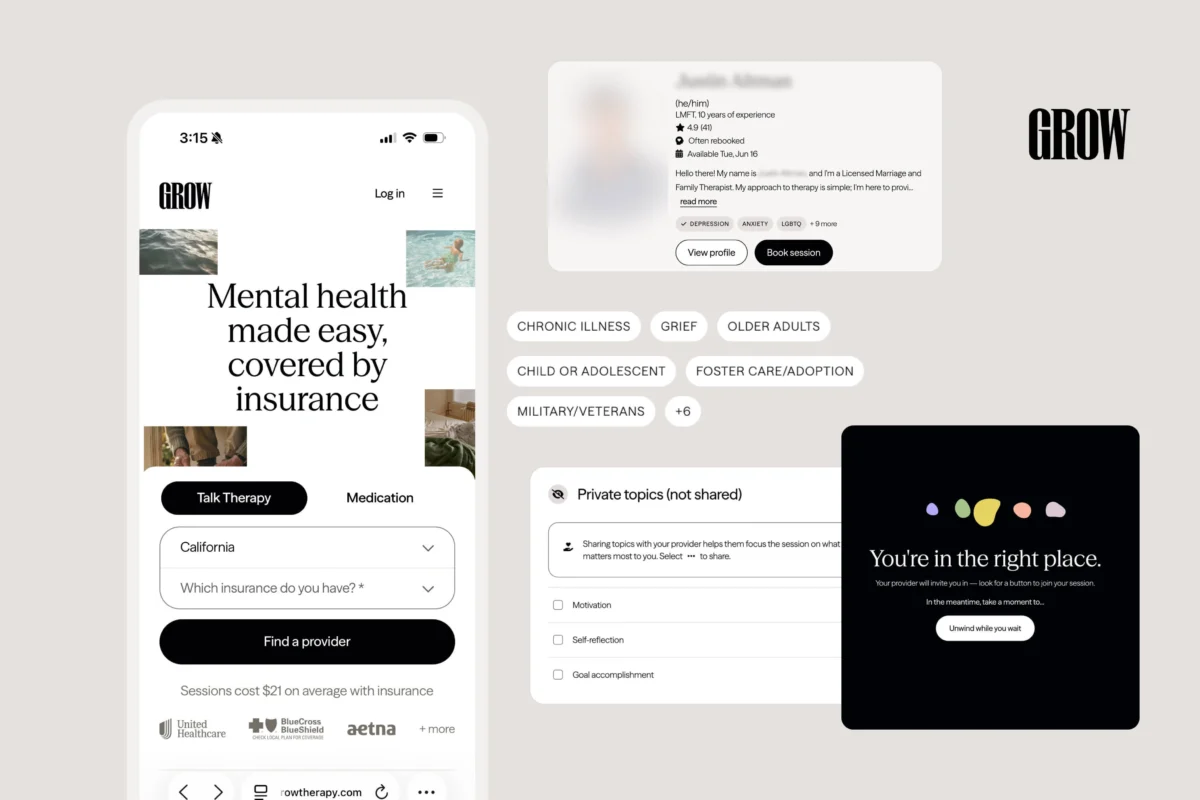
Grow Therapy is an online platform that offers therapy, medication management, and psychiatric services through a network of more than 26,000 providers. It’s available in all 50 US states and accepts over 125 insurance plans, including Aetna, Anthem, Cigna, Blue Cross Blue Shield, and United Healthcare, as well as Medicaid and Medicare in some states.
The platform uses a pay-per-session model. In other words, you only pay for the sessions you book. This can be a significant benefit for users who want to avoid being locked into monthly subscriptions that other platforms offer.
HelpGuide evaluated Grow Therapy over a two-month period, using both its therapy and psychiatry services and assessing the experience at each stage of the process. We also surveyed over 200 Grow Therapy users and asked them to rate different aspects of the service and share their feedback. Here are a few key findings from our research:
| Roughly 84% of surveyed users were satisfied or very satisfied with Grow Therapy’s therapy services |
| About 84% were satisfied or very satisfied with their first therapist match |
| 61% were able to schedule their first therapy session within 3 days |
| 84% said it was easy or very easy to navigate the platform |
| All surveyed users who reached out to customer support said their issue was resolved to their satisfaction |
| 95% of psychiatry users said they were satisfied or very satisfied with the medication management and psychiatric care they received from Grow Therapy |
In our best online therapy, best online therapy with insurance, and best online psychiatry reviews, Grow Therapy was a top pick across the board.

4.6
Grow Therapy excels in several areas.
To evaluate Grow Therapy firsthand, our team spent a full month actively using the platform and documenting the experience along the way. This involved completing the registration process, booking and attending therapy and psychiatry sessions, and reaching out to customer support with questions. We also explored additional platform tools, such as the therapist messaging feature, which is available between scheduled sessions.
Alongside our hands-on testing, we conducted surveys of 200 Grow Therapy users (100 who used the therapy services, and 100 who used the psychiatry services). This allowed us to get broader insight into the platform’s performance. Through extensive questionnaires, participants shared feedback on areas such as ease of use, cost, data privacy, provider quality, and their overall satisfaction with the service. Combining our direct experience with this user feedback gave us a well-rounded understanding of how Grow Therapy performs and how it stacks up against other online therapy and psychiatry platforms.

Enter location, needs, and insurance provider into the search page

Select a provider from the filtered list

Complete sign-up and intake
Getting started with Grow Therapy was quick and easy. It took us about five minutes to complete the initial intake, then we were able to immediately select a provider. During the intake, you’re given the option to search specifically for in-person care or virtual care. For this review, we focused on virtual care.
Some therapy apps automatically pair you with a provider based on your preferences and answers in the intake questionnaire. On Grow Therapy, you make the final choice from a list of provider options based on your own selection criteria. You can view each therapist or psychiatrist’s bio before scheduling. You’re also able to see their availability, qualifications, and ratings and reviews from other users.
The platform allows you to search for providers based on over 60 specialties, such as depression, anxiety, ADHD, and trauma. You can also filter your search based on factors like gender, sexual orientation, religious background, and ethnicity. You can even search for providers who use a particular approach to therapy, such as psychodynamic therapy, cognitive behavioral therapy (CBT), family and couples therapy, and EMDR. The amount of options really impressed our team and makes it easier to find someone who understands your perspective and meets your needs.
The Frequently Asked Questions section at the bottom of the provider search page could be particularly helpful to anyone trying out virtual therapy for the first time. It included answers to questions such as “What happens during the first therapy session?” The page felt designed to gently ease new users into the experience.
We found the Grow Therapy platform very intuitive to use and easy to navigate. The dashboard neatly laid out our therapist’s details, when our appointment was, and the messaging features for communicating between sessions. When we started testing psychiatry services, we noticed the dashboard automatically updated to include our psychiatrist as well.
About 84 percent of the users we surveyed agreed with us that the platform was easy or very easy to navigate. On the other hand, although we didn’t personally encounter any glitches or tech issues during our hands-on testing, some in our survey reported issues with the app crashing or freezing.
As for customer support, when we submitted a question, we received a response within 10 minutes. They gave us a call and stayed on the phone until the issue was resolved. Like us, all surveyed users who contacted customer support reported that their issue was resolved to their satisfaction. However, response times varied, with only about 13 percent saying they received a response within 24 hours. Most waited one to three days.
When asked how confident they were that Grow Therapy would protect their personal information, about 81 percent of the users we surveyed said they were confident or very confident. Respondents gave similar ratings when asked if their conversations with therapists felt secure and private. Grow Therapy’s privacy policy is also easy to find and presented in plain language. During our own testing, we didn’t encounter any concerns over data security or the privacy of our health information.
That said, we did have some concerns about the privacy implications of the platform’s AI Coach. The coach offers tips and support between therapy sessions, and anything you share with it is also shared with your therapist—an important safeguard that’s vital for an AI tool used in a mental health setting. However, because AI chats can feel like private, one-on-one conversations, some users may not realize that their therapist will see these messages, potentially leading them to disclose something they didn’t intend to share.
Ultimately, that’s not a bad thing. An AI chatbot is never going to be able to provide the insight and perspective of an actual person, let alone a mental health professional, so we appreciate that these conversations give therapists additional insight into what’s happening between sessions. We just think this should be made very clear to users before they begin chatting with the AI Coach.
After scheduling our first therapy appointment, but before the first session, we had to complete an intake questionnaire about our history and needs. The form had about 40 questions but only took us around 10 to 15 minutes to complete.
We gave Grow Therapy top marks when it came to provider quality. The therapist we selected was focused, empathetic, engaged, and a great listener. Each session was helpful, and the therapist was very responsive between sessions when we messaged her.
The same was true when we tested out the psychiatry services. Our psychiatrist gave us clear answers to all our questions and honest information about various medications and their side effects. He also advised us on multiple treatment options, including a recommendation to see a local psychiatrist for ADHD treatment, since many first-line medications are controlled substances and require close monitoring.
The users we surveyed were impressed with their providers as well. About 84 percent were satisfied or very satisfied with their first therapist match. Most had positive words to share: “Great therapist, open mind and inclusive,” said one respondent. “My therapist gave me the tools to use to become more assertive,” said another.
Psychiatry users also gave favorable reviews. 94 percent of our survey users said their Grow Therapy psychiatrist was responsive or very responsive to their questions and concerns. The same percentage said their psychiatrist was clear or very clear when explaining medication side effects.
Each therapy session was an hour long. The therapist followed up afterward through direct messaging and offered additional resources. We noted that the platform allows for unlimited messaging between sessions without charge.
The psychiatry session had a more structured form, with the provider asking questions about our medical history and current medications. He also listened and responded carefully to our questions before laying out various treatment options.
Slightly more than half of respondents said they also received a mix of casual and structured support in their sessions. Surveyed users reported that some of the most therapeutic approaches or techniques that were used during sessions included:
Most surveyed users stuck with their first provider; only 26 percent ever switched therapists, and only 25 percent ever switched psychiatrists. However, most of the users who switched said the process was easy or very easy. You can switch providers by simply selecting the option on the dashboard.
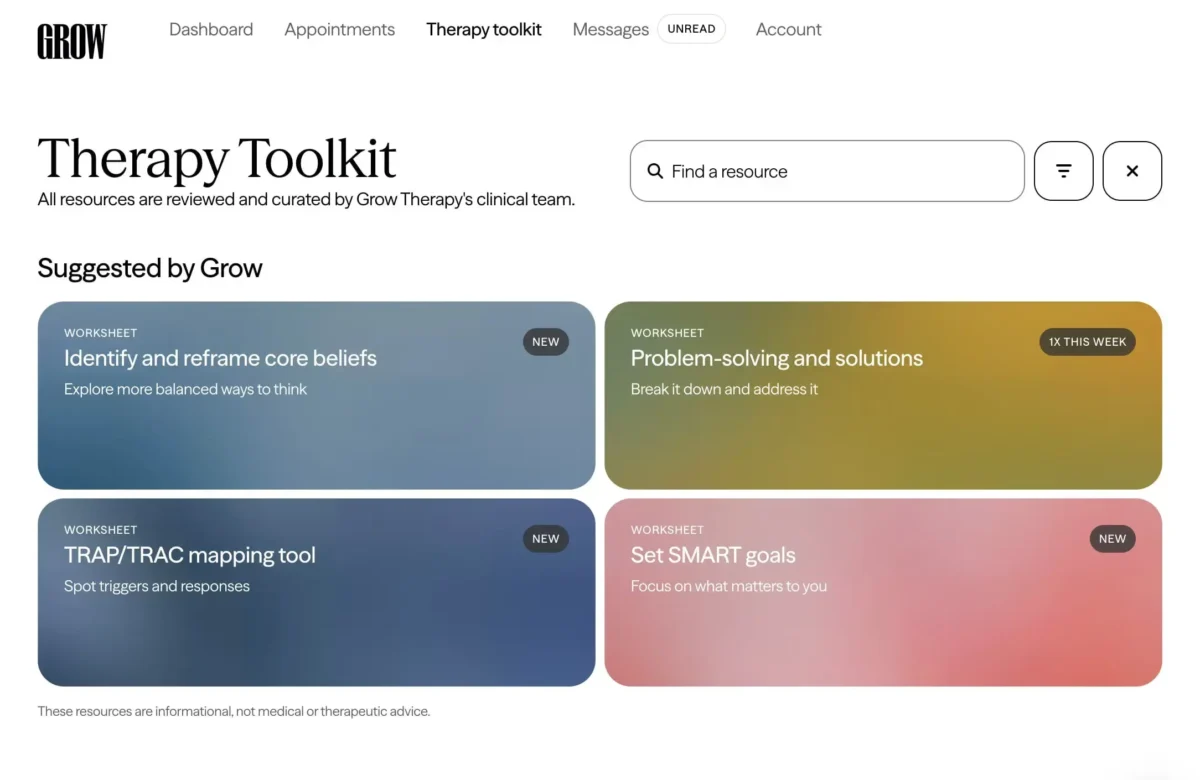
Many platforms offer tools and resources to supplement sessions, giving users an opportunity to practice skills or self-reflect. On Grow Therapy, these items appear in the “Therapy Toolkit” section. Here, the platform presents all sorts of resources, such as worksheets on setting SMART goals and reframing unhelpful beliefs. All of these tools are reviewed and curated by the platform’s clinical team. It’s also possible for individual providers to share their own personal resources that aren’t linked to the Grow Therapy platform.
The platform also offers a “check-in” feature. A series of between-session questions allows you and your provider to track your depression and anxiety levels, as well as your overall quality of life.
As previously mentioned, Grow Therapy also offers an AI “coach” that’s intended to provide support between therapy sessions. Messages shared with the AI chatbot are also visible to your provider. We haven’t had the opportunity to fully test it, but in our experience, the Coach is fairly limited in what it will offer. It can provide basic suggestions, such as breathing exercises and other coping strategies, but it generally avoids giving substantive mental health advice and will often direct you back to your therapist. We consider these limitations a good thing. We don’t believe AI chatbots should be used as a substitute for professional mental health support, particularly when they lack the judgment and clinical expertise of a human therapist. At the same time, these safeguards mean the Coach may feel less useful to someone looking for more personalized guidance between sessions. Grow’s approach is ultimately more about reinforcing what you’re working on in therapy than trying to replicate therapy itself.
| Pricing plan: | Pay-per-session; no subscription required |
| Starting price: | $0-21 average copay with insurance ($75-200+ per session without insurance) |
| Insurance accepted? | Yes |
| Financial aid: | Yes |
| Therapy types: | Individual, couples, family, teen, child |
| Session formats: | Video, audio, and text messaging |
| Time to first session with therapist: | 1-2 days |
| Psychiatry & medication: | Yes |
As mentioned, Grow Therapy follows a pay-per-session approach. This sets it apart from large competitors like Talkspace and BetterHelp, which both use monthly subscription models. When paying out-of-pocket, prices on Grow Therapy can range from $75 to $300, depending on the provider you select. Some users may find the differences in cost to be confusing.
For insurance users, the platform’s average copay is $21. It accepts more than 125 insurance plans, as well as Medicaid and Medicare in some states.
For therapy, we used insurance and had a copay of $15 per session. For psychiatry, we paid $200 out of pocket. However, we noted that had we used insurance, we would’ve paid a $15 copay—the same as our therapy sessions.
About 34 percent of our surveyed users reported either receiving financial aid or a discount from Grow Therapy. The platform allows for limited financial assistance, called “charity care” for users who are paying out-of-pocket and can’t afford the rates.
The cancellation process for Grow Therapy is extremely easy due to its pay-per-session model. To avoid a late cancellation fee, cancel your appointment at least 24 hours before the scheduled session.
As of October 2026, Grow Therapy has more than 9,000 reviews in the Apple App Store, resulting in a 4.8 out of 5 star rating. Based on our own testing experience, this high rating isn’t a surprise.
Grow Therapy stands out for the size of its provider network, making it a solid choice if you’re looking for a therapist with a specific area of expertise. The platform can also help connect you with a local provider, and some Grow Therapy providers offer in-person visits, so you’re not just limited to online sessions. This is particularly helpful if you’re the type of person who wants the occasional face-to-face interaction with your provider.
Grow Therapy is designed to be simple and intuitive, so it’s a good fit even if you’ve never used an online therapy platform before. On top of that, the platform accepts a wide range of insurance plans, and with insurance, the average session is $20 or less.
Finally, rather than locking you into a monthly subscription, Grow Therapy lets you pay per session. This is a setup that you might find more convenient, especially if your therapy needs or schedule tends to fluctuate.
Overall, we think Grow Therapy is an excellent choice for anyone looking for an easy, accessible way to connect with a qualified therapist or psychiatric provider—especially if you want a wide selection of options, the ability to use insurance, and the flexibility to schedule appointments on your own timeline and pay as you go.
We’d love to hear from you! Your feedback helps us improve and make sure you’re finding the support and information you need.

HelpGuide's review of the online psychiatry platform, based on personal testing.

Infidelity can devastate a marriage, but healing is possible.

Certain over-the-counter anxiety medications might help calm your mind. Explore the benefits, limitations, and risks of natural remedies and supplements.
We surveyed real couples who used Regain, and a HelpGuide staff member personally tested its services with a partner. Here’s what we learned about the couples therapy platform.

We surveyed real Sesame Care users and a HelpGuide staff member personally tested its mental health services. Here’s what we learned about the platform’s usability, provider quality, user satisfaction, and more.

Clonidine is a medication used to treat high blood pressure. But it might also be useful for managing anxiety. Learn more about how this medication works and its side effects.

Millions of readers rely on HelpGuide.org for free, evidence-based resources to understand and navigate mental health challenges. Please donate today to help us save, support, and change lives.
Donate to HelpGuide.org today